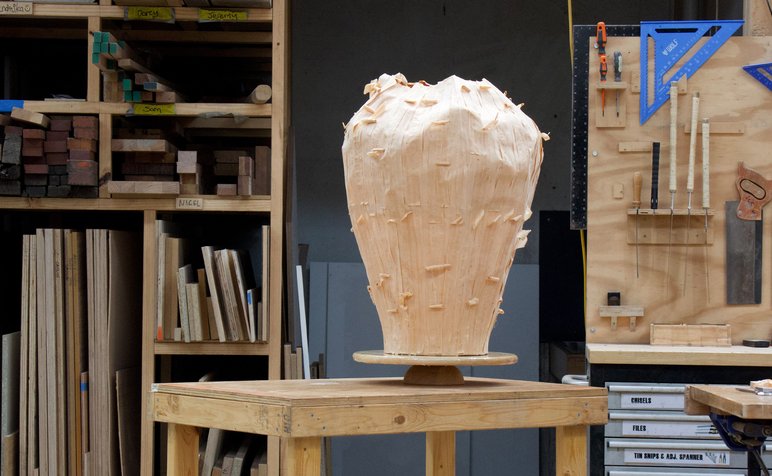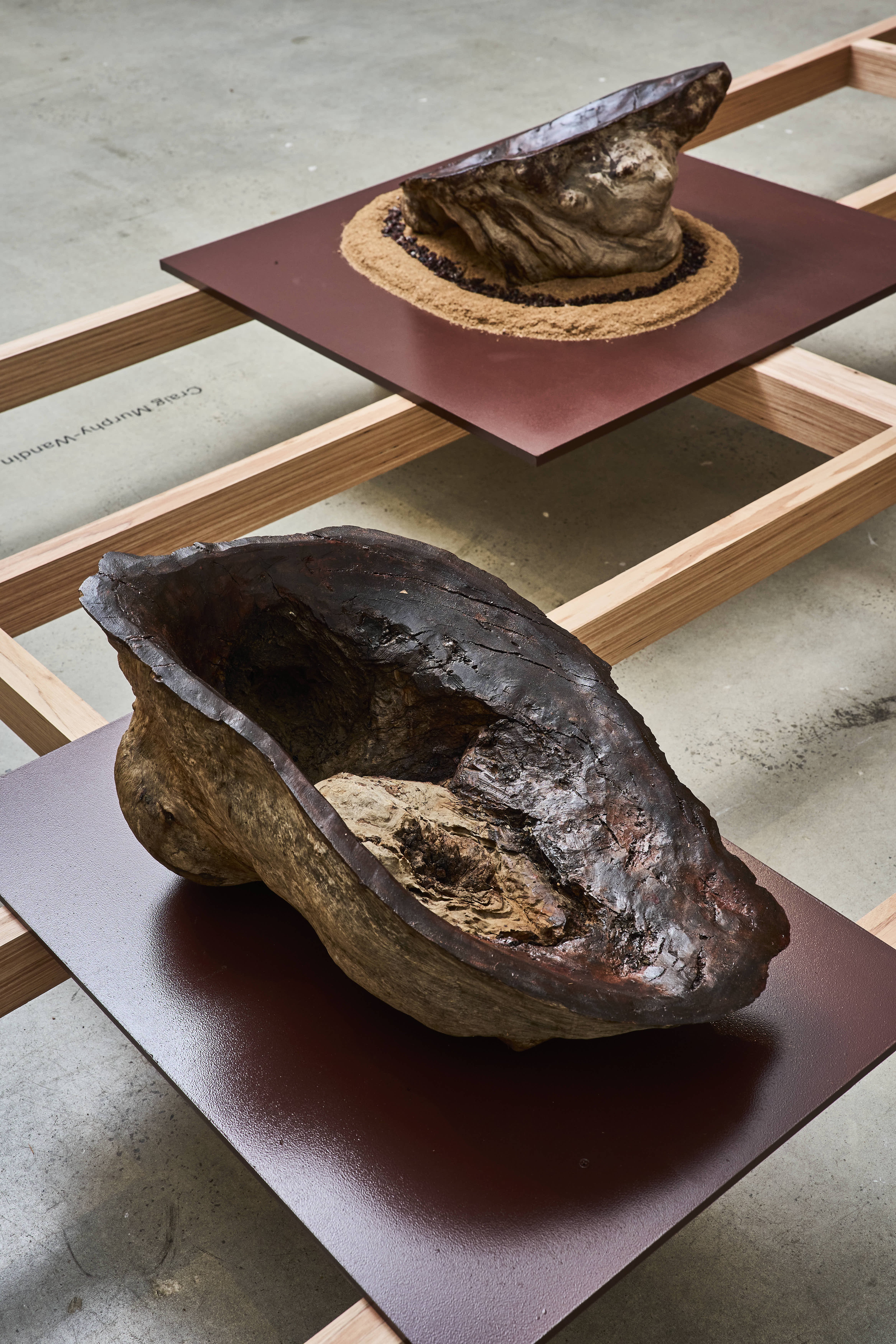
Read the catalogue essay for Felled, by Pete McCurley.
Can I ask something of you? It is an offering ask as much as an asking.
Go find yourself a tree.
Pick a great one. You know what I mean. There are trees amongst trees.
Look for a tree whose life story is described by its form. The opportunities it has reached into. It is lineage, the family way. It is place. Prevailing winds? How does the light find it? How good is its ground? How have its life storms written themselves on it?
How does it feel? How do you feel in your tree’s company?
Who else is there? Who can you see and hear? A buzz of bugs or the hint of home in a hollow?
Who are this tree’s birds?
Allow yourself a moment’s peripheral empathy. Who are your birds?
How many questions can you bring to meeting a tree?
Those lead-ins.
Somewhere alongside all the activity and noise of the minds meeting, something else might rise. Or you might have felt it there all along.
Character.
Your tree is its own person. It has a way, it holds itself.
Of course there are infinite other questions. Other lead-ins to cultivate your capacity for attention.
Some are asked of the hand, instead of the eye.
As a maker will.
To experience yourself as part of the world is to work with the world. There’s nothing else. No where else.
That’s our everything.
Country.
To craft wood is to collaborate. Our character and the tree’s character conversing.
In meeting a tree, it is good to recognise that you’ll quite possibly feel a bit stupid.
A bit of social shame always piggybacks unconventional behaviour. But how would we expect other things to happen if we just do the same things? You’ve got to stretch a bit. Embrace the cringe.
The colonised mind is deeply acculturated into maintaining separation.
The ‘self-managing neoliberal subject’ polices themselves with guilt and shame.
Whichever our own aspersions.
Then there is the tree itself.
You can’t just walk up to a tree and ask questions. That would be dumb. Trees don’t just open up like that.
You need to ‘pull-up’ alongside your tree. Be attentive to how you are holding yourself. How is your internal noise? Are you so busy in there that there’s no room for curiosity? Attentiveness?
If we want to understand wood as the body of a tree, a whole new suite of questions arises. We can leave most of that language to the maker.
But there’s one we will need here.
A tree’s body is time, place. If you were to hammer a nail into your tree ... I know, fair enough, you probably wouldn’t want to. But hypothetically. That nail would occupy exactly that same place in the world till the tree fell. It doesn’t get higher as the tree grows. A tree doesn’t stretch. It grows from the tips. And that nail doesn’t move outwards. As your tree adds girth new wood is added to the outside, in that magic layer under the bark. Cambium. That nail is much like everything the tree experiences. It is all recorded in the tree’s body. It’s recorded AS the tree’s body.
A tree’s body is time, place.
Such that those learned in that language can read what happened in that time, to that part of the tree.
The arc of these words bends towards something broader. That’s our human way.
Whether we are training our attentiveness to a tree or to each other. We could map the movement of a single rock into the road in front of us right out through that stone’s mountain morphology.
That attention.
The curiosity.
Context.
By whichever set of tools, we sharpen our senses.
As for the wood we work.
There is the craft.
Pete McCurley is a craftsperson of Ngarabul-Gumbaynggirr / Gaelic heritage who lives on Dja Dja Wurrung country (Daylesford), Victoria, Australia. He runs a small custom timber mill called Curly Timbers, where he processes high-quality Australian timber, primarily sourced through salvage: storm-felled trees, council removals, and farm burn piles. His work goes beyond traditional woodworking by treating materials as sentient gifts, reflecting the deep, continuous relationship between people and the environment. He frames his carving and making as a collaborative process, offering a pathway for both Indigenous and non-Indigenous people to understand better the embodied knowledge held within the landscape.