New approach to material in craft and design practice
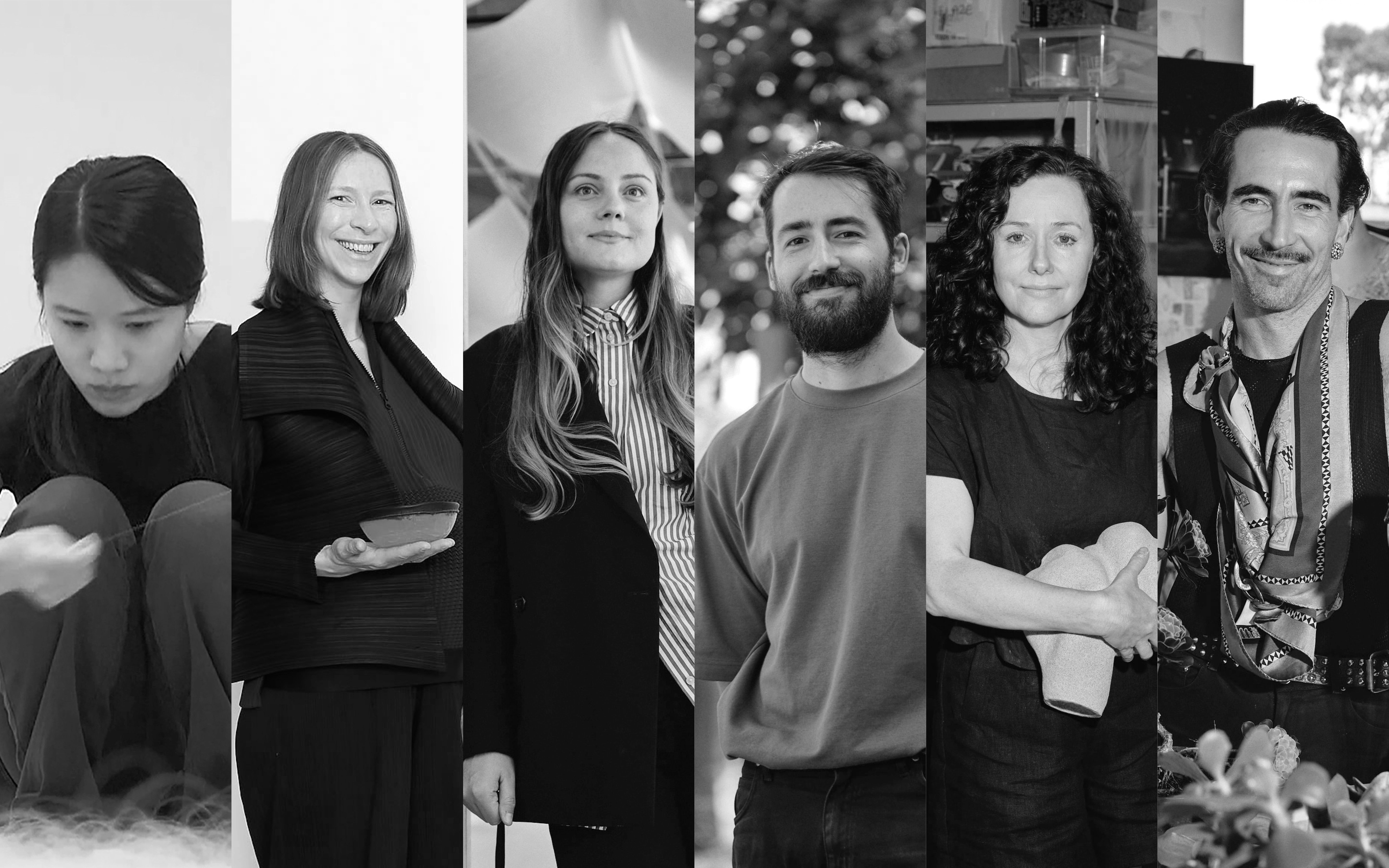
Our six inspiring artists featured in Alternative Provisions shared their stories behind the chosen materials and their approach to material practice.
-
What drew you to BioTextile research?
Having practiced as a fashion and textile designer for more than two decades, I’ve become increasingly frustrated by the lack of environmentally sustainable textiles available to fabricate my design products. This frustration led to a hiatus from industry practice to undertake a (recently completed) research-led masters degree, enabling a deeper comprehension of the environmental impacts of the fibre, fashion and textile industries. Through this research journey, I began working with bacterial cellulose (BC) to determine if BC biofabrication methods can be optimised to make fit for purpose biomaterials with a mitigation of environmental impacts.
Tell us what it is like working with this material?
Historically, humans have obtained textiles from terrestrial plants, animals, minerals and petrochemicals. In recent years, it has become increasingly apparent that fibres can also be obtained from non-traditional sources including cellulosic fibres from hydrospheric plants such as algae, protein fibres from mycelium and cellulosic secretions from microorganisms. For Alternative Provisions I’ve worked with the microbial secretions of Komagataeibacter xylinus (a microbial species) which has opened the potential to utilise bioregional waste (e.g. vegetable food waste) as feedstock for the production of biomaterials. It has been truly fascinating exploring the potential of these nanofibrillar three-dimensional matrices (i.e. non-woven textiles created by microorganisms) as eco-alternatives to the incumbent sources of the aforementioned fibres.
There are myriad challenges that remain to transform BC from a speculative biomaterial of the future, to a green material of today. Nevertheless, there is an emergent community of interdisciplinary biodesign practitioners with whom I share confidence that continued biomaterial research may bring textiles into a circular and ecologically sustainable economy.
Why do you think we need to reflect and reevaluate our approach to material in craft and design practice?
Since the dawn of the first industrial revolution, our species has become increasingly disconnected from the biorhythms of nature, evidenced by numerous anthropocentric changes we've observed through this period including the reduction of biodiversity, deforestation and melting of polar ice caps; All important cofactors culminating in climate change. On this basis, the reimagining of design materials will be crucial in reducing the environmental impacts of the materials we produce, to mitigate their aggregated impacts on the environment.
What is the responsibility of the maker?
While a shift towards more responsible modes of engaging with material objects needs to be holistically embedded across all levels of design, use and disposal, I strongly believe design has an integral role in reducing the ecological impact of consumerism. That is, it is not only the responsibility of governments and corporations to legislate more progressive policies and for consumers to buy, use and dispose of their products more ethically. Rather, these responsibilities must be shared by the spectrum of creative practitioners seeking to design and produce material objects. The biomaterials I’ve cultivated for this exhibition speculate on how artisanal artefacts may be grown in ways that align with Earth’s natural cycles of birth, life, decay and rebirth.
-
Can you tell us about the material that you have chosen to work with for this exhibition?
For this collection, I have chosen to repurpose recycled glass through the process of rammed earth. Unfortunately in Australia, there is an abundance of recycled glass that is being either stockpiled or put in landfills, as there is no major commercial use for the material at this stage.
By experimenting with this process and material I wanted to identify a better application for this waste glass that demonstrates commercial opportunities while also avoiding a manufacturing process such as glass blowing, which has a high embodiment of energy. Rammed earth consists of nothing more than compacted soil with a small percentage of concrete, and is traditionally hand compacted.Despite not requiring industrial machinery, constructions produced using rammed earth have demonstrated remarkable longevity, with buildings lasting for thousands of years.
What is exciting about the material you are working with? / what is the biggest challenge?
The exciting element of rammed earth is always the layered effect that is produced in the making process.
As this material is produced in a closed mould it is only until the object is completed that you can remove the formwork and see just how beautiful the effect is. With the addition of recycled glass, this has only enhanced the effect. As with closer inspection, you will be able to see subtle glimmers of glass particles that catch the light.
For this project the biggest challenge was in finding the correct ratio of soil, glass and cement. This involved a thorough amount of sampling and testing with the use of a pneumatic ram for a controlled result.
How important is it for us to reflect and revaluate our approach to material in craft and design practice?
To me, that's just what I define design as being - a reflection of material and process.
In any project, I believe the material should be considered very carefully, as this influences the tone, the positioning, elements of sustainability and the look and feel.
What is the responsibility of the maker and their approach to material practice?
I feel all makers have a large responsibility when using materials, but I don't think that's limited to designers and artists.
Take for example the construction industry which is one of the world's largest consumers of materials and natural resources, and consequently a large producer of waste materials. As an industrial designer who has designed and developed commercial products for plastic injection moulding or glass moulding in the thousands, I feel I had a large responsibility in either designing the object as efficiently as possible, as desirable as possible, or to somehow make use of recycled materials in the production process.
-
Why have you chosen to work with left-over sawdust as an additional composite in your algae-based bioplastic?
Trees, as well as all plants that perform photosynthesis, contain the DNA of an algae within the chloroplast in each of their cells. It is thought that a process of evolutionary symbiosis between cyanobacteria, simple single-celled microalgae, and what eventually became every green terrestrial plant.
I thought that making use of this by-product timber use would be, as well as an interesting material exploration, a nod to this link on a cellular level between the two base ingredients.
On top of a new kind of materials, by incorporating the usually discarded by-product from another maker’s studio (furniture maker Thomas Lentini), the work extends the utility of materials and increases the usage of resources.
This was a new experimentation process which garnered a lot of knowledge in how this and other waste materials could be used in new recipes for algae-based bioplastic.
Why do you think we need to reflect and revaluate our approach to material in craft and design practice?Nothing lasts forever, and nothing should. We’ve created more than enough that will take up space on this planet and refuse to break down for an impolite amount of time.
Those at the design and craft end of things make conscious choices about materials and with this power comes a responsibility to make sure we aren’t endlessly extracting non-renewable resources and bringing more and more into circulation that won’t be reused at the end of its current form.
Where do you see this material going? How do you see it being used in the future?The waste involved in daily life weighs heavily on me. The sheer scale of material that cannot be easily recycled and the environmental cost of its production is outrageous. It’s uncomfortable to think about. There’s certainly a lot of potential in this material. It’s overwhelming what it could be and the ways it could be integrated into everyday life to solve a huge issue we have with waste and the use of petrochemical plastics.
For those who are new to your practice, what exactly is bioplastic algae? and how is the material developed?Bioplastic algae is a type of plastic - or rather a material that is malleable, shapeable or pliable. We usually associate the term plastic with synthetic material, however, bioplastics are those made from organic materials, and algae-based bioplastics are those made specifically with algae as the main ingredient.
I use both macroalgae and microalgae in my work. Macroalgae is the stuff we mostly think of as seaweed - you can see it with your naked eyes. Microalgae is tiny stuff. It is usually only visible as coloured water but under a microscope, these single-celled organisms are visible as whole parts.
The macroalgae I use is processed relatively simply through a process of washing it to remove salt and sand, then boiling it and concentrating the liquid over a series of similar processes. It is then dried and ends up as an odourless cream powder and that’s what I use as a base for the polymer. There is some more information about my research on this in Morocco here.
The microalgae is used whole. I can simply use the water from the bioreactors growing it in my studio or I can pour this over a mesh to drain the liquid and give it a rinse before adding it to a mix. I use this microalgae as a pigment but because it also has some microscopic mass to it, it adds structural integrity to the material as well. The dark colours that look black in my pieces are actually very dark green microalgae called Athrospira platensis.
-
What is important about the process of making your own clay body?
I am curious about how materials behave (including ideas around material agency or animacy) and I enjoy deciphering their poetic effects. Working with an unruly clay-body brings me close to how materials feel and behave. I enjoy observing how they reveal their personalities in processes of making and how they disclose their effects in the kiln.
I particularly enjoy clay-bodies that are wilful and rebellious. These clay-bodies are forever crumbling or collapsing. They refuse my invitation to do one thing and instead do another. They insist on a conversation or negotiation. It’s a process that teaches, maddens, humbles and inspires me.
A side effect of this process is a qualitative shift in the way I value the work. Having physically invested in formulating a work’s material composition, and being a witness to its metamorphosis, I am invested in its care and conservation. The work is one of a kind. The materials are finite.
My processes are a little different to conventional ceramics, which has traditionally foregrounded the enduring and impermeable object. I am indebted to these traditions but also interested in works that are short-lived in the world. I make highly granular clay-bodies that are low in plasticity and extremely impractical. They can be willful and rebellious – forever collapsing, cracking or crumbling. They resist or refuse my invitation to perform a certain way, and they surprise me by doing something else entirely. It’s not always easy to relinquish control and follow the material. But this way of working delights and inspires me. I embrace the process, and the works teach and humble me. And to be honest, the works make choices in the kiln that I would never have imagined and they are much better for it. Most of my works are fired multiples times in a creative cycle of collapse and repair. Every test and ‘failure’ is carefully preserved and folded back into new sculptures. The unlikely ceramic artefacts that arise can invite a close and curious gaze. They may excite our desire to contemplate and decipher material phenomena. I see this spark of curiosity or recognition as a reminder of our kinship with the material world.
Why do you think we need to reflect and re-evaluate our approach to material in craft and design practice?
Artists, makers and designers are intimately attuned to matter. Developing an art practice has taught me the reciprocity of material enquiry. It is a critical dynamic to recognise. What we do to the planet, we do to ourselves. Molecules of the clay we know today have evolved over millions of years, and this warrants our care and attention.
The word ‘material’ is often taken to denote ‘something we might do something with’. But such an instrumentalist approach to the material world has got us into trouble. I wonder if there are other ways of thinking.
My personal hope is to articulate an ethic of care through my work. I am thinking about the quality of artist-material relations and how this manifests in an artwork. Working in collaboration with matter requires recognition of mutual interdependence. It is critical to examine the way we think about seeing materials.
What is the responsibility of the artists, makers and designers to material practice?
Like most practitioners, I am keenly aware that elements of my practice (and elements of ceramics in general) are simply unsustainable. I wonder about the environmental legacy of my work and where we are headed. I am full of questions and unsure of answers.
For clay-workers puzzling about all of this, perhaps I can suggest the ‘Potters Pledge’. Written by a group called Clay Matters (claymatters.com.au), the pledge is about making sustainable and ethical choices. Referring specifically to clay and kilns, its mission is “to encourage clay workers to lead and inspire climate action, embed environmentally friendly and sustainable practices in the studio, and strengthen individual and social commitments to carbon reduction”.
What is exciting about the material you are working with?
I love the playful, tactile messiness of an unruly clay-body. And sometimes, at lucky moments, I love the unexpected feats it performs in the kiln.
