Exhibition Catalogue Essay, written by Anna Varendorff
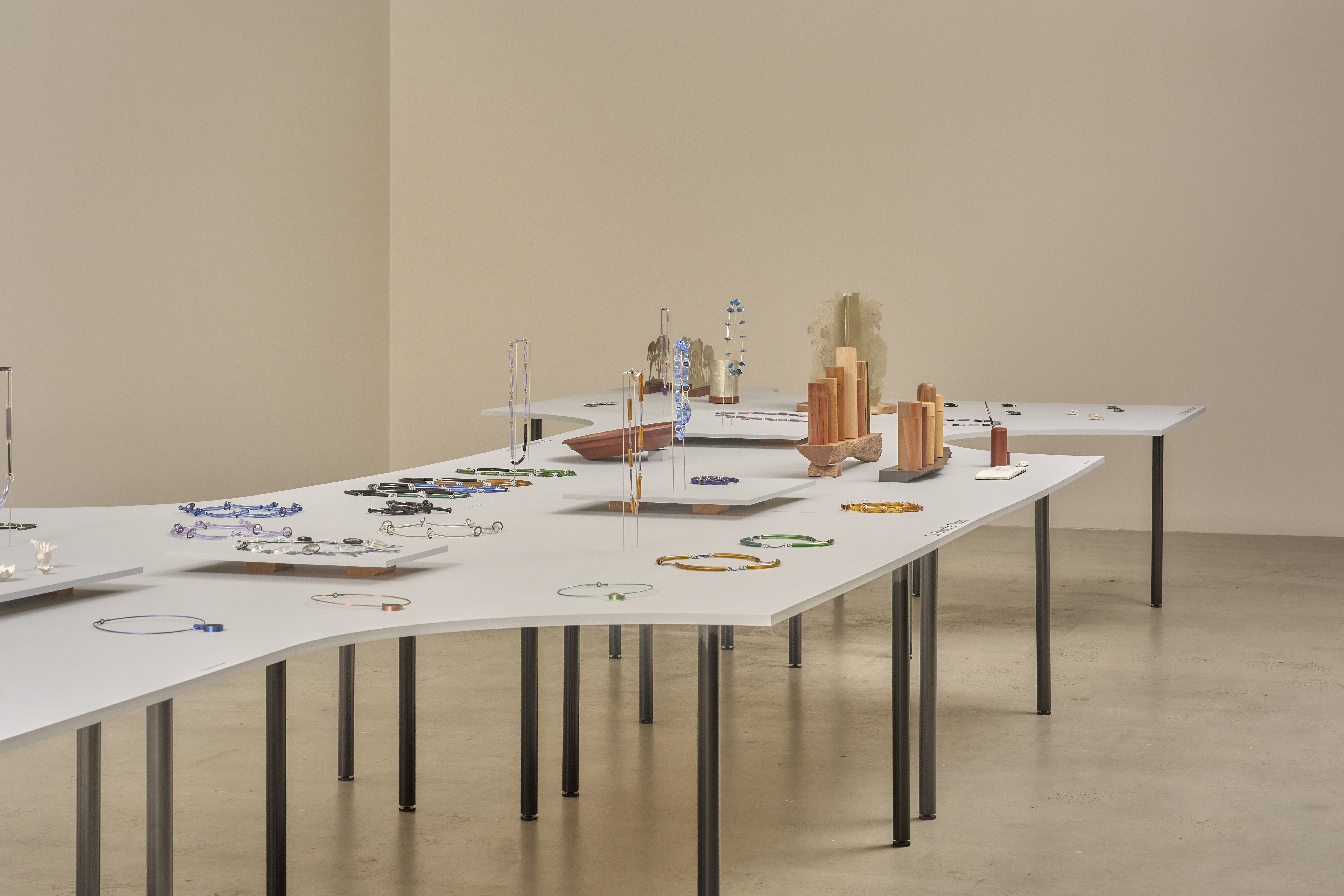
Lean In is an exhibition featuring three of Australia's most renowned contemporary jewellers: Laura Deakin, Dr Marian Hosking and Dr Blanche Tilden.
Leaning in is to share the load. It is to trust that you will be supported by another. It is to work together, to collaborate. Over the course of years and geographies Blanche Tilden (b. 1968), Marian Hosking (b. 1948) and Laura Deakin’s (b. 1979) practices have repeatedly leant towards each other.
Sharing scale, intellectual rigour and a patient persistence with materials, all three jewellers have, for decades, prised forms from matter as skilled craftspeople, into objects of desirability and storytelling, in order to probe and examine systems that inform our lives.
Making jewellery that performs conceptually is difficult. Fine jewellery, historical, cultural, and fashion jewellery are visually familiar to most people, allowing for stylistic variations. But Contemporary Jewellery with a capital C is lesser understood. This classification of jewellery, emerging in the 20th century in tandem with the social and political upheavals of world wars and global capitalism, engages in contemporary critique, and cultural commentary. How can artists present meaning from this language of object making? And how is it that we can catalyse critical thinking through jewellery objects despite their diminutive scale and ornamental function?
There is, in common for Tilden, Hosking and Deakin, an insatiable need to process ecological and sociological concepts with their hands and minds, into the creation of objects. Colleagues and friends, the tapestry of their connections is extensive. Hosking’s connections to Canberra, Germany, to Monash University and to Gallery Funaki connect her to Tilden, and to Deakin; Tilden and Deakin have taught together and made work together; Deakin and Hosking have taught together, worked together and travelled together. All have mentored. Mentoring is a theme of this collaborative endeavour. For the artists, sharing and passing on of knowledge is vital, both to the field of Contemporary Jewellery as a community and, towards ensuring that the practice of jewellery making disseminates outwardly, engaging and including people from all places and walks of life.
Together the three artists have created new works for Lean In where overlapping motifs and a sharing of techniques, have resulted in new work for each, shown alongside works of significance from their respective oeuvres. Meanwhile, each retain the personal language that emerges from the mind and hands of a maker that is uniquely their own.
Jewellery has been part of the human experience in every culture and across every continent. And, perhaps in a way, what characterises jewellery as different from other art forms is that the resultant object is released into the world to be animated by a wearer, to infiltrate social spaces and be noticed by others, to agitate subtly, and to participate in daily life.
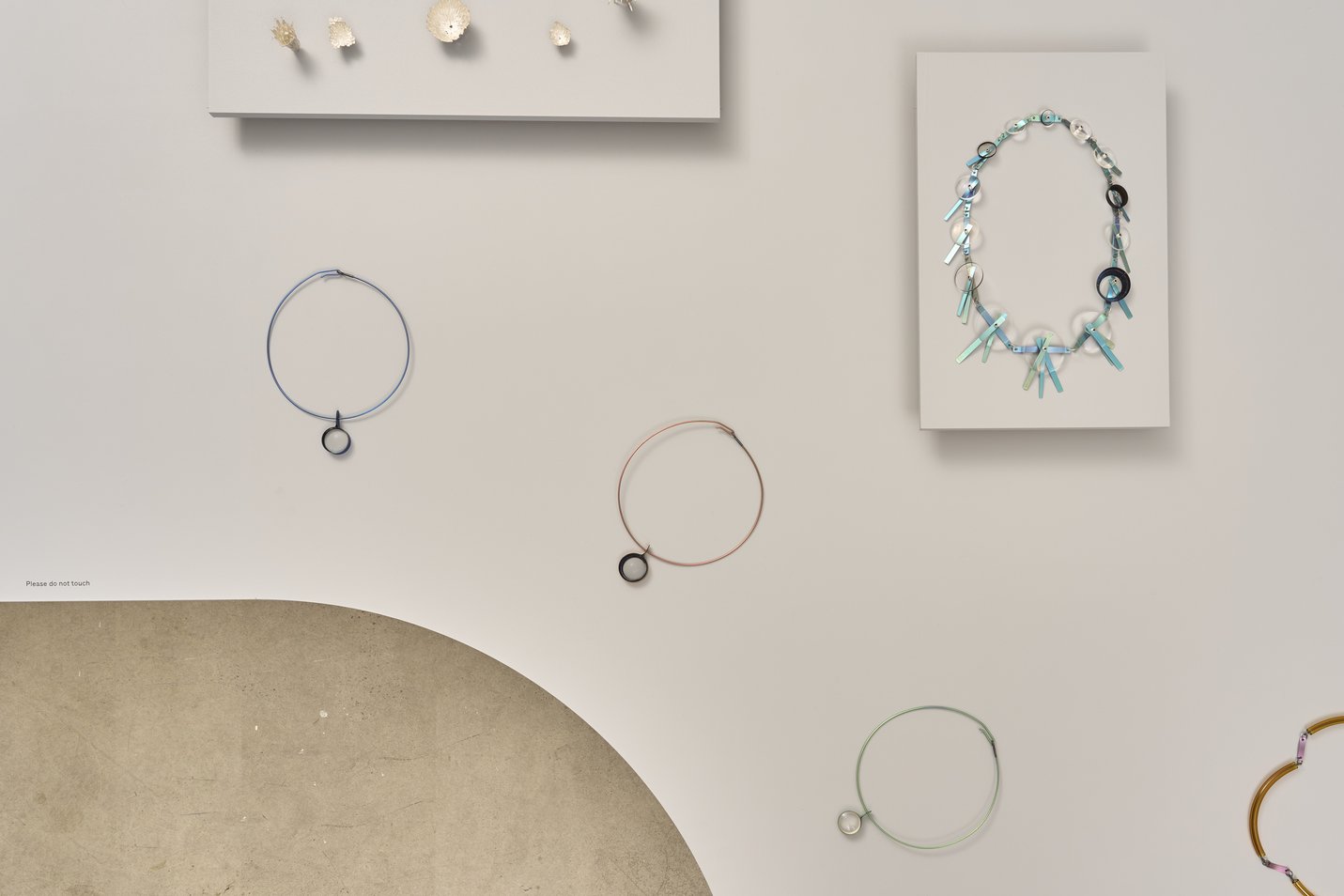
Made from native timbers fallen and gathered, Marian Hosking returns to a principal concern of her practice: to examine, record, observe and share the botanical world of this ancient continent, so-called Australia. For Lean In she has used salvaged samples of some of the beautiful timbers that have, for millennia, covered this continent and which continue to perish at human hands. She shapes these salvaged timbers into something covetable, a souvenir, a tool for mindful activity in the form of a painter’s kit, inviting us to see, feel, smell and hold material and places which may soon be gone forever from the natural world. Hosking’s jewellery, for Lean In combines jewel coloured titanium with sterling silver, generous in proportion, articulating flora sometimes in perfect botanical detail, sometimes stylised. Sculptural vessels employ silhouettes describing ancient eucalypt forests. Meditations on the natural world and its vulnerability, these works ask us to slow down, value, and to preserve what is left of indigenous flora and the natural environment.
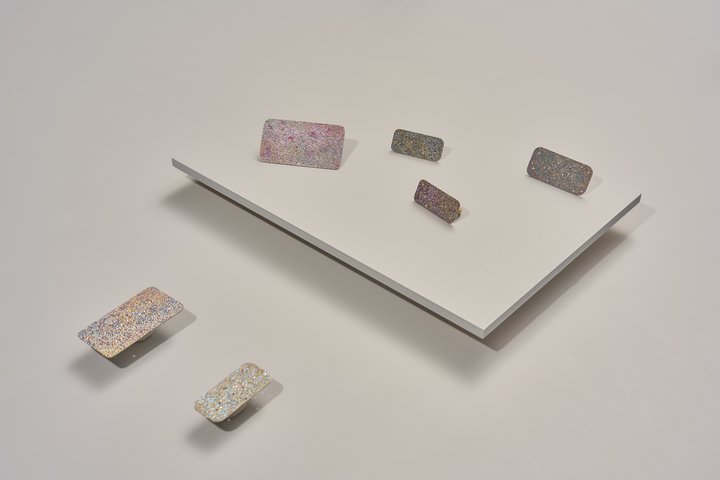
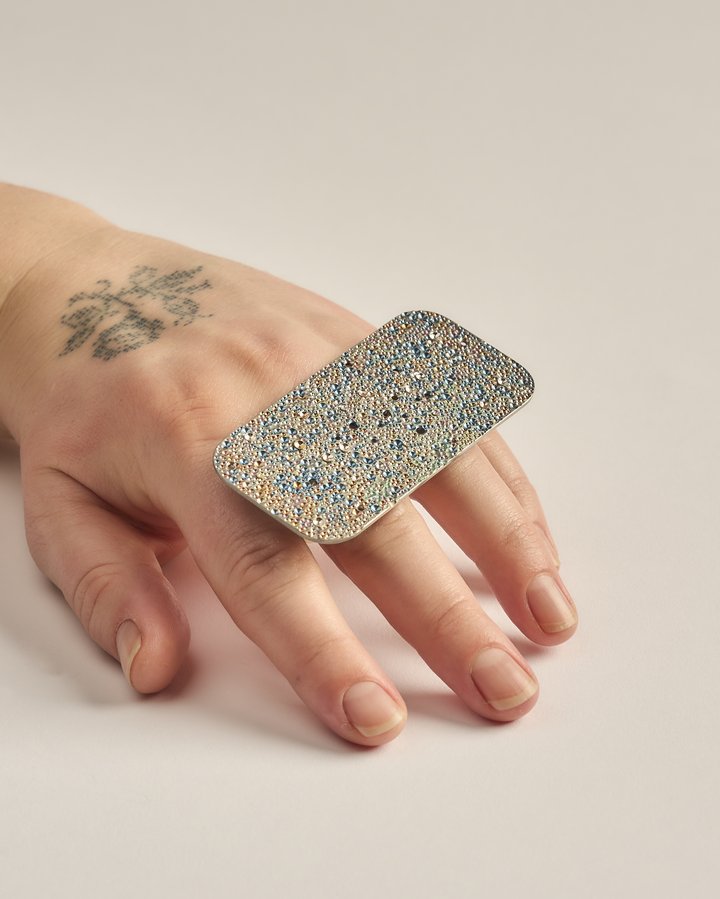
Pixelation, a method of recording and transposing, repeats themes of documentation in the works of Laura Deakin. Her rings, like Hosking’s work, evoke the natural environment, this time using colour and repetition to build up traces reminiscent of the natural world. Titanium, its surface etched and drawn on to, is then electroplated with help from Tilden. Becoming a transfixing colour field of secondary hues evoking wildflowers, ocean and foliage in shadow, giant sculptural rings carry the painterly layers of colour on to wearable forms. Earlier works by Deakin, setting fragments of micro-plastics in rings of lace-like gold or silver claw settings, revel in delicate colour gradations. Technical skill merges with Deakin’s acute observational eye inviting us to associate her use of colour and materiality with human-made incursions, and to ponder the effects of these.
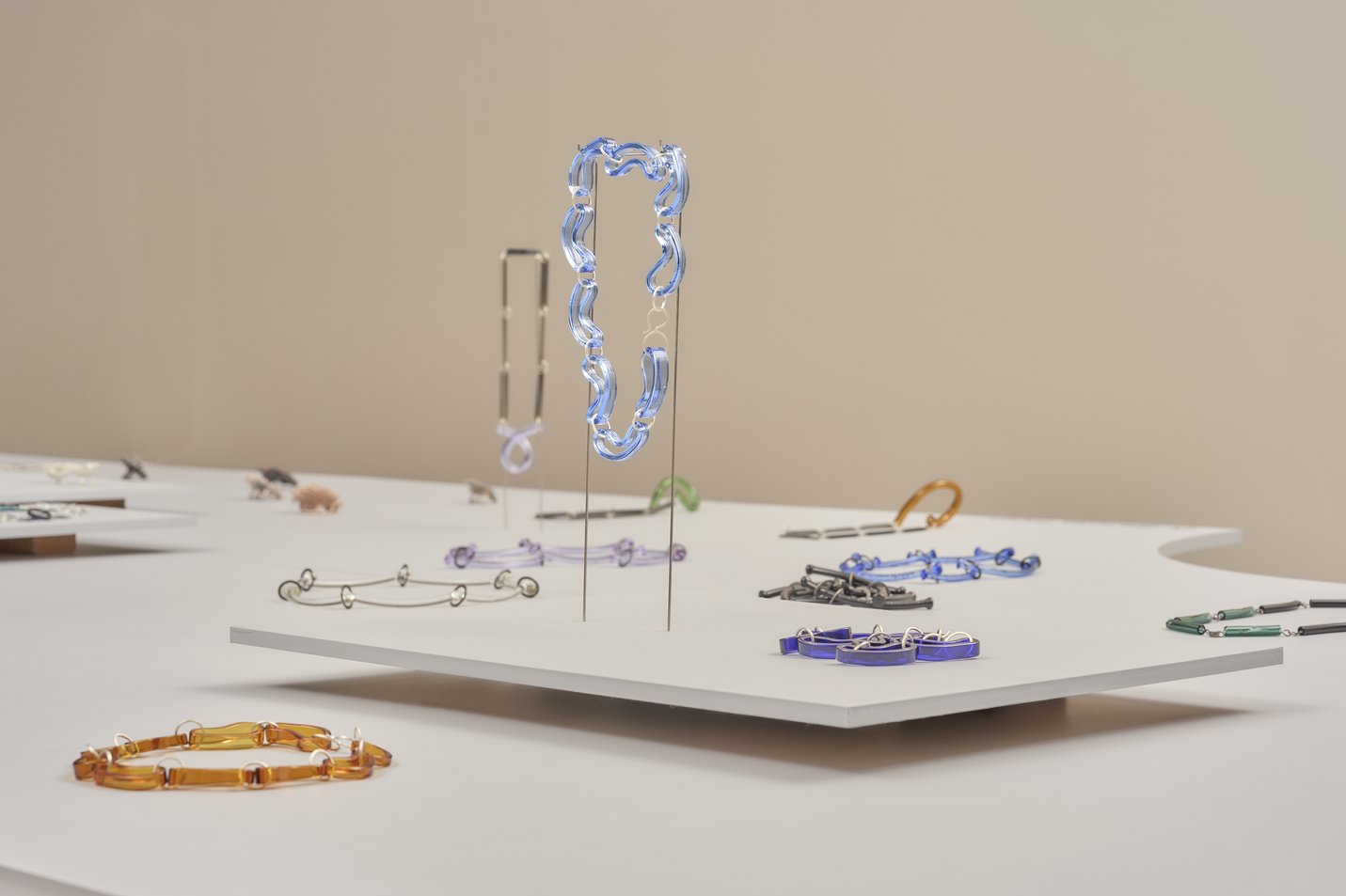
Enmeshing unlikely companions in glass and metal, Blanche Tilden’s neckpieces of colourful borosilicate glass twist and turn in their progress around the body. The precision, clarity and tension which her works typically embody here reaches into softer territory. Interspersing crisp edges with sinewy forms, Tilden’s neckpieces are in shades of lilac, blue, green and amber coloured glass. Delicate saw pierced native orchids appear in one work, articulated blue green titanium tassels in another. These pieces are playful, joyous. A celebration of material and of a collaboration of parts. She employs production methods that evoke industry, but through which she asks us to examine the methodology and the value of the artisan. The seemingly mechanical systems that underpin the aesthetics of the work melt into softness through the translucency of the glass and the movement of articulated forms.
Tilden’s technical generosity is visible in the brightly coloured titanium flowers in her own work that appear similarly in Hosking’s, and in the colour fields of Deakin’s rings. The sharing of technical knowledge in the works for Lean In bind the pieces, and the artists, into an enriched dialogue.
Embedded in the critique of systems of value that characterises Contemporary Jewellery practice, the works in Lean In shun materials of gratuitous rarity or conventional market value, whilst employing the skills of traditional jewellery making. There is an application of the Bauhaus principle of truth-to-materials in Hosking’s use of found wood, Deakin’s integration of microplastics, and Tilden’s harnessing of glass, all in conversation with silver as a fundamental material of jewellery construction. As we move societally towards digital captivity, the skills it takes to make such work are themselves increasing in rarity value. The outcome are compositions that ask us to think about the world around us, and our behaviours as social beings. These pieces are a celebration of resistant thinking through making.
Craft (Victoria, established in 1970) has been, through its invitation to the artists, a fourth collaborator. Its place in the Australian gallery landscape is hinged on the materially diverse artists whom it represents and in a canon of making that merits both the craftsperson, the artisan and the thinker. From this perspective, the organisation brings together creative languages that, through materiality and method, form fields of research. Beyond the makers guild, Craft balances criticality with skill and ingenuity, in order to support artists thinking about the politics of their times through craft production. And in Lean In, Craft has initiated an exhibition about skill and purpose through the lens of friendship and jewellery.
For each of these jewellers, preciousness is a result of skilled labour, informed critical thinking, divergent application of materials, and the collegiality that conceptually enmeshes them. The artists have spent their lifetimes leaning in, to follow an idea with a physical action of precision and purpose, inviting us to join them.